Fewer Pieces, More Pressure: The Quiet Anxiety Hiding Inside Minimalist Wardrobe Culture
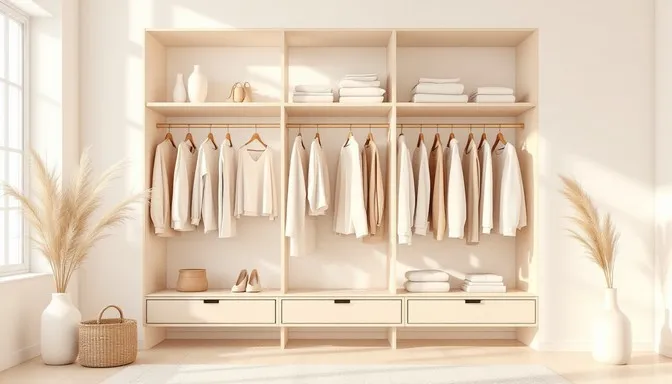
Photo: minimalist wardrobe closet neutral tones organized hangers, via images.stockcake.com
The capsule wardrobe arrived with the confidence of a manifesto. Strip your closet to its essentials. Invest in quality over quantity. Wear only what serves you. The logic was clean, the aesthetic was cleaner, and the lifestyle promised felt almost medicinal — a corrective to decades of fast fashion excess and Sunday-morning closet paralysis.
Yet somewhere between the promise and the practice, something went sideways.
For a particular segment of thoughtful, style-aware consumers — the very people most drawn to the capsule ideal — the minimalist wardrobe has not delivered liberation. It has delivered a new and more refined form of indecision. The closet got smaller. The stakes, somehow, got higher.
When Curation Becomes Its Own Burden
The mathematics of the capsule wardrobe seem straightforward: fewer items means fewer decisions. Cognitive load decreases, mornings become fluid, and the self is freed to focus on more meaningful pursuits. This was the founding logic, and it is not entirely wrong.
But it contains a quiet assumption — that the act of building the capsule is itself simple, or at least finite. In practice, many consumers discover that the opposite is true. When every item in a wardrobe must justify its inclusion, every potential purchase becomes a weighted judgment. Is this piece versatile enough? Does it work with the three other items it must work with? Is the color palette cohesive? Will I still want this in five years?
Dr. Carolyn Mair, a behavioral psychologist who has written extensively on the relationship between clothing and identity, has noted that decision fatigue does not simply arise from having too many choices. It arises from any situation in which the perceived cost of a wrong decision is high. In a maximalist wardrobe, a regrettable purchase is diluted by volume. In a twelve-piece capsule, it is conspicuous. Every mistake is structural.
The result, for many consumers, is a kind of suspended state — a closet that never quite feels finished, and a shopping process that never quite resolves. They are not buying impulsively. They are researching, deliberating, returning, and starting again.
The Aspirational Trap
There is a particular image that recurs across the capsule wardrobe aesthetic: a spare, light-filled room, neutral tones, a row of perfectly spaced hangers. The wardrobe is not merely functional in this image. It is a portrait of a person — calm, considered, unencumbered.
This is where the capsule wardrobe departs from practicality and enters the territory of aspiration. And aspiration, by definition, describes a self one has not yet become.
Many consumers building capsule wardrobes are not building for the lives they currently lead. They are building for an idealized version — one with a more consistent daily routine, a more neutral personal palette, a more streamlined social calendar. The teacher who also coaches weekend soccer. The marketing director who travels for work but also hikes on weekends. The new parent whose body and schedule have both shifted considerably in the past year.
Real lives resist the capsule's clean geometry. And when the wardrobe fails to accommodate the actual texture of a person's days, the instinct is rarely to question the framework. It is to question the self.
What Fashion Psychology Actually Tells Us
The discipline of fashion psychology — still an emerging field, but a substantive one — offers a more nuanced picture of how clothing functions in the construction of identity. Clothing is not merely utilitarian, and it is not merely expressive. It is relational. What we wear communicates something to ourselves as much as to others, and that communication is fluid, contextual, and deeply personal.
A wardrobe that reflects genuine identity is not necessarily a minimal one. For some people, a rich and varied closet is a form of self-knowledge — a record of moods, occasions, histories, and becoming. For others, a spare collection of well-chosen pieces genuinely does produce clarity. The difference lies not in the number of items but in the degree of alignment between the wardrobe and the person it is meant to serve.
The capsule framework, in its most prescriptive iterations, tends to flatten this distinction. It offers a universal architecture for a deeply individual problem.
A More Honest Approach to the Functional Closet
What would it look like to build a wardrobe around a life, rather than around an ideal?
The answer begins with inventory — not of clothing, but of context. What does a representative week actually require? Where does the day begin and where does it end? What activities recur, and which are occasional but important? What does dressing for each of those moments feel like, and what role does clothing play in that feeling?
From that foundation, a wardrobe can be built that is neither minimal nor maximal by prescription, but appropriately scaled to the life it must serve. Some people will find that a compact, versatile collection genuinely meets their needs. Others will find that they require a wider range — more categories, more variation, more room to move through different versions of themselves on different days.
Both are valid. Neither requires justification against an external standard.
At RFLCT, the guiding principle has always been that style is a reflection — not of a trend or a template, but of an individual. The capsule wardrobe, at its best, offers one possible lens for that reflection. At its worst, it substitutes someone else's clarity for your own.
The Permission to Be Specific
There is something worth recovering from the capsule movement, even as its more rigid prescriptions deserve scrutiny. The underlying impulse — to be intentional, to resist accumulation for its own sake, to ask whether what we own genuinely serves us — remains sound.
But intentionality does not require minimalism. It requires honesty. Honesty about the life you are actually living, the body you actually inhabit, the occasions you genuinely encounter, and the version of yourself that dressing well is meant to support.
The most functional wardrobe is not the one with the fewest pieces. It is the one that makes you feel, on any given morning, that you have exactly what you need. That number will look different for everyone. And that, finally, is the point.